Orica is a global mining services provider operating in 45+ countries, supporting safety-critical work through field operations, manufacturing, corporate functions and technical specialists.
Client
Orica
Service
Microsoft 365 Copilot
Organisation size
Large
Industry
Mining
Context
Microsoft 365 Copilot was already in Orica’s hands. An established cohort of 466 licensed users had held licenses for more than a year, with 100 more rolled out during the programme. Orica’s ambition reached beyond tool access: it wanted a workforce that could apply AI confidently, safely and consistently in the flow of everyday work.
Engage Squared partnered with Orica’s Organisational Capability team to pilot a layered Copilot adoption programme covering individual productivity, leadership advocacy and the foundations of agent-led value.
Challenge
The barrier was maturity, not access. People at Orica were already using Copilot, but depth of use and consistency varied widely across individuals, teams and regions. Awareness of newer features and better practices was patchy, and many users had settled into narrow habits formed in their first weeks with the tool.
Baseline measures of usage made the gap explicit, with only 53% of staff feeling like they had the training they needed to use AI effectively, and communication about how AI was being used in the organisation scored 65% favourable. Across corporate, technical and operational roles in 45+ countries and multiple time zones, a single generic curriculum was never going to bring a workforce this diverse to a consistent level of AI literacy.
The challenge was behavioural as much as technical: help people see where Copilot genuinely fits their own work, give them the prompting skill to reach a good result first time, and give leaders enough fluency to model and endorse new ways of working credibly.
Solution
Engage Squared designed a practice-led capability programme built on a single principle: people build AI skills by doing, not by watching. Every session included an activity or practical exercise, so participants could apply, reinforce, and test what they had just learned before returning to their work.
- Scenario-based skill building: a fundamentals module plus four applied streams (Communicate it, Create and refine it, catch up on it, and Analyse it) covering real scenarios across Teams, Outlook, Word, Excel and PowerPoint. Sessions ran in waves aligned to regional time zones, with on-demand viewing for those who could not join live.
- Prompting clinics: guided, hands-on practice in writing, refining and reusing prompts, so people could reach a usable outcome in fewer attempts instead of abandoning a task after a weak first result.
- Leadership exercises: senior-leader sessions (“How to for you” and “Enabling your team”) that built personal fluency first, then equipped leaders to coach their teams and advocate for new working practices with credibility.
- Interactive knowledge checks: short in-session checks that confirmed understanding in the moment and gave facilitators a live read on where more support was needed.
- Measurement and feedback ran throughout: pre-and post-programme surveys, a virtual focus group, attendance data, and Copilot Dashboard analytics gave Orica a continuous view of capability, sentiment, adoption and value.
Results
Experienced users discovered how much more was possible
The most consistent theme in feedback came from people who believed they already knew Copilot well. Participants left sessions having discovered features they did not know existed, prompting techniques that measurably improved their results, and new ways of applying Copilot to work they had previously done manually.
Capability uplift against baseline
- Feeling equipped: staff who felt they had the training they needed to use AI effectively rose from 53% to 92% favourable, a 39-point improvement.
- Confidence: 92% agreed they felt more confident using AI after attending training.
- Prompting skill: only 10% of users needed six or more prompts to reach the outcome they wanted, evidence that improved technique was carrying back into daily work.
- Understanding of AI across the organisation: communication about how AI was being used scored 65% favourable at baseline and improved through the programme.
Engagement and applied practice
540 unique attendees logged 2,121 live session-attendances and 360 on-demand views. 72% attended two or more sessions and attendees averaged 4.7 sessions each, sustained participation rather than one-off exposure.
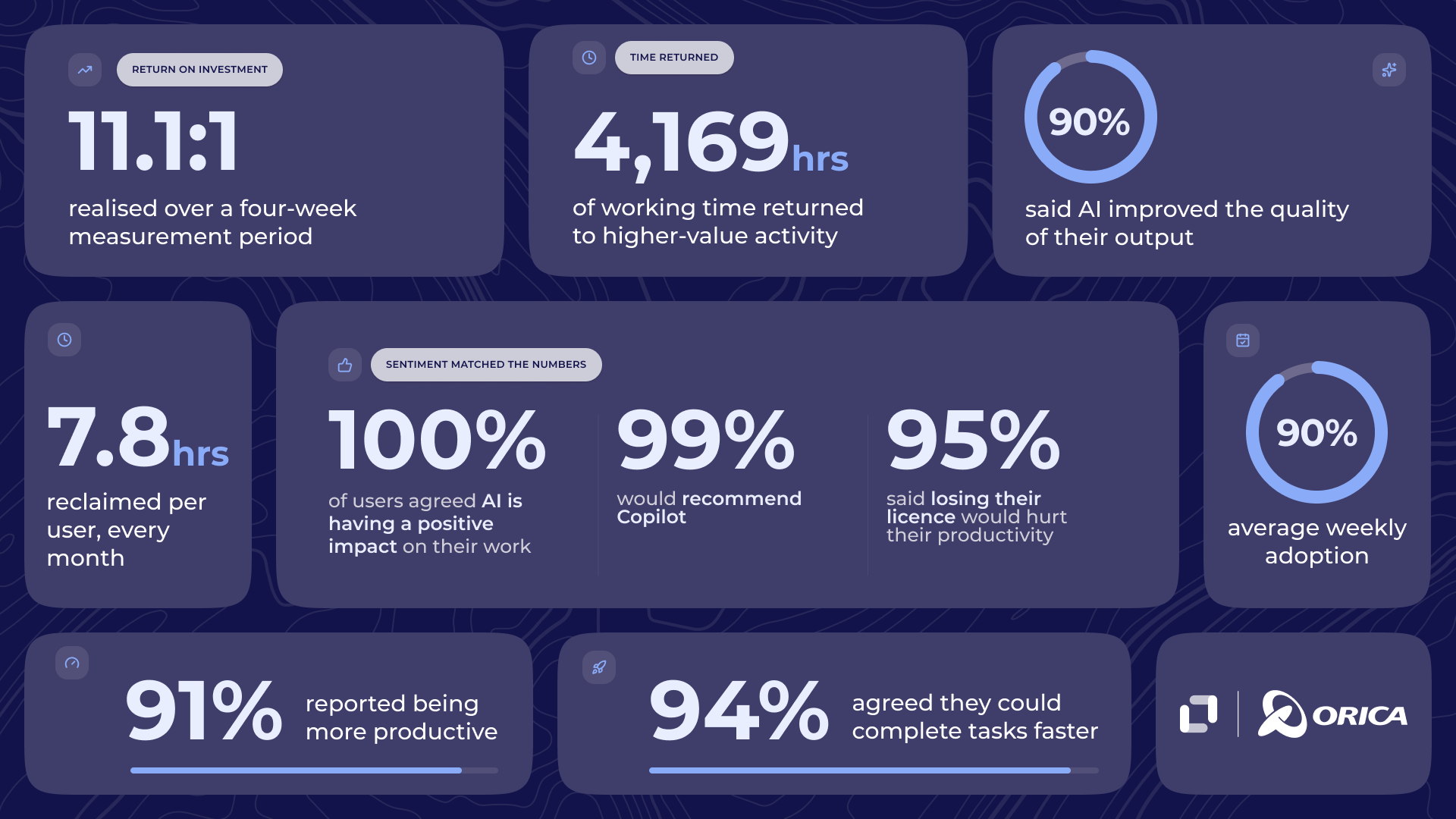
Sentiment matched the numbers: 100% of users agreed AI is having a positive impact on their work, 99% would recommend Copilot, and 95% said losing their licence would negatively affect their productivity.
The programme exceeded targets across capability, adoption, sentiment and ROI. More importantly, Orica’s people began using Copilot to support real work, from meeting catch-up and email drafting to document creation, research, Excel analysis, reporting and process documentation.
The impact was both measurable and human. Users reported faster task completion, higher-quality outputs, reduced effort on repetitive work, and more capacity for higher-value activities, reinforcing the practical value of the adoption effort.
The training programme resonated because people could connect it directly to day-to-day work. Users praised the hands-on demos, prompt guidance and examples across Outlook, Teams, Excel and Word, while the improvement in prompt confidence showed the learning was translating into new habits.
Beyond individual productivity, the engagement opened new conversations about where AI could support repeatable team and departmental workflows. Users began exploring opportunities such as meeting actions, reporting, troubleshooting guidance and administrative automation, giving Orica a clearer pathway for future agent-led value.
The engagement also surfaced the implementation barriers Orica would need to address as adoption scaled, including inaccessible source systems, confidential SharePoint files, PowerPoint brand fidelity and the need for more role-specific training. These insights shaped clear recommendations for the next phase, including role-based learning, a Pioneer network, connector feasibility analysis, value review cadence and operational guardrails for safe agent use.
Final thoughts
This initial engagement helped shape a more confident, applied and people-centred path for AI adoption across Orica. The organisation is now scaling its partnership with Engage Squared beyond the pilot and expanding to 3,200 Copilot licenses, with a clearer view of how AI can support everyday work at scale. The next phase will build on that momentum through targeted sessions on human-in-the-loop practices, helping teams address common challenges such as AI “slop” and strengthen the judgement, review and governance needed for safe, high-quality AI use.
It will also introduce Microsoft’s prebuilt agents as a practical way to unlock agentic AI value without development effort, while departmental proofs of concept will help teams translate individual capability into repeatable workflows. For more complex opportunities, Engage Squared will support Orica with proof of concept, bringing specialist developer capability to explore where tailored agents can deliver meaningful operational value.