
Published Octgober 7 2026
Across K–12 and higher education, institutions are being asked to improve student outcomes while managing workforce strain, learning gaps, rising security risks and growing administrative demands.
Educators already spend a significant share of their time on non-teaching tasks.
AITSL’s June 2026 National Trends report found that full-time classroom teachers reported a median working week of 50 hours during term, with almost one in five spending 10 or more hours on administration.
Meanwhile, valuable information remains spread across learning platforms, policy libraries and operational systems. Schools and universities have more data than ever, but often lack the connected systems and capacity to turn it into timely, useful insight.
At the same time, education providers must prepare learners for an economy in which AI literacy will become an increasingly important capability, while building their staff’s confidence in using AI responsibly. These demands create a practical opportunity for AI agents to reduce routine work, improve access to trusted information and return time to teaching, learning and student support.
The encouraging part is that education organisations are often trying to solve similar problems. Across our work, we’re seeing repeatable patterns in instructional planning, assessment and feedback, student support, policy access, family communication and school operations. That means each organisation doesn’t need to start with a blank page. We can build on what’s working and adapt it to each institution’s people, information and technology environment.
Read on as our Channel Marketing Manager, Jack Hendy, explores some of the agents we’ve been building for education and our new offerings to help institutions make work better and create more time for their students.
Three agents showing what’s possible with AI agents in eudcation
1. OneSchool Global Assignment review agent
OneSchool Global worked with Engage Squared to implement an agent using Microsoft Copilot Studio, connected to Canvas Learning Management System and SharePoint. Educators select the curriculum pages to be reviewed, and the agent checks the content against relevant standards and marking criteria before producing structured feedback and a completed rubric in Microsoft Word. Human approval remains part of every review.
The agent reduced review time from up to 60 minutes to 15 minutes, a 75 per cent improvement that saves an estimated 3,000 educator hours each year. It’s a clear example of agentic classroom support, with AI taking on repetitive review work while educators retain professional judgement and control.
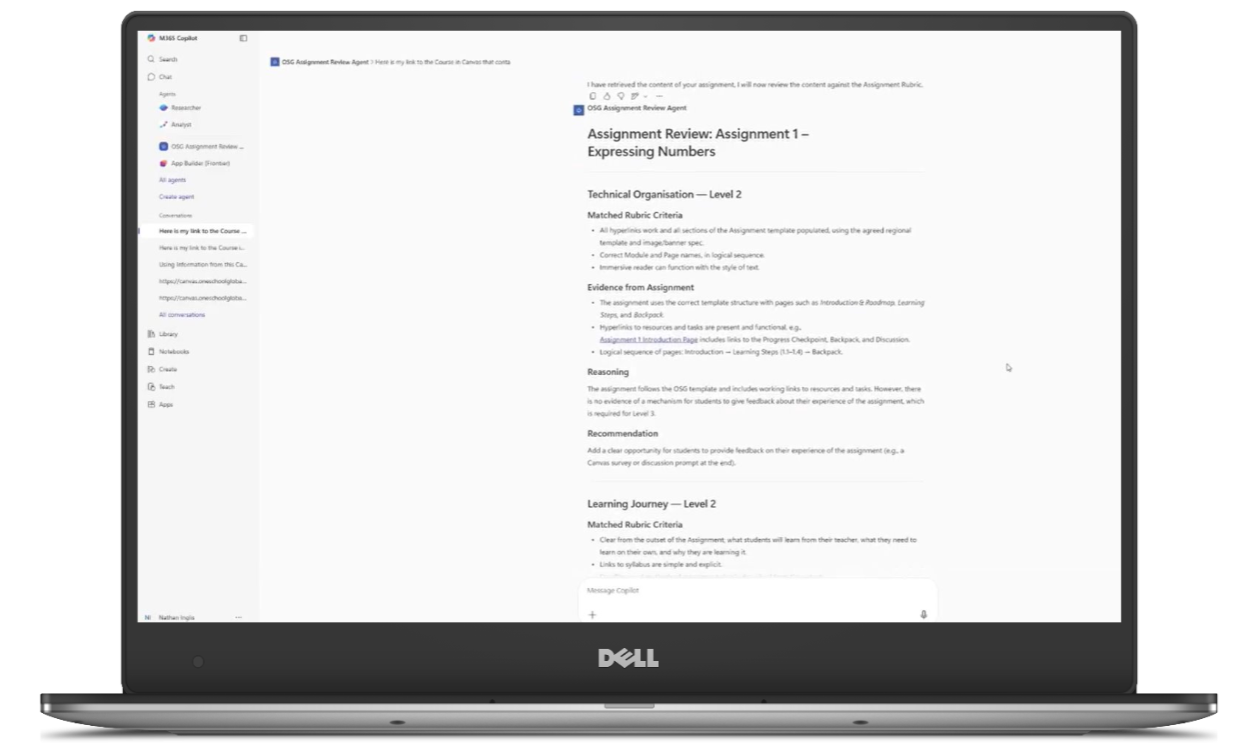
OneSchool Global Assignment Review agent
2. Lesson planning agent
A Lesson Planning Agent can support educators and curriculum teams by generating curriculum-aligned lesson plans, learning sequences, classroom activities and teaching resources. It can map content to learning outcomes and help educators differentiate materials across year levels and learning needs.
The purpose isn’t to replace educator expertise, instead it’s to reduce repetitive preparation, improve consistency and create more capacity for teaching, learning design and direct student support. This aligns with Microsoft’s focus on using AI to support instructional planning and differentiation while keeping educators at the centre of the learning process.
3. School policy agent
A School Policy Agent helps teachers, administrators and support teams find information across approved policies, procedures and legislative sources through natural-language questions. It can reduce the time staff spend searching across repositories, provide more consistent guidance and show which approved source supports an answer. This pattern can be adapted to each institution’s policies, permissions and compliance requirements. It also supports a broader need across education: establishing trusted and secure access to information as AI becomes part of everyday work.
Moving from individual agents to institution-wide capability
The next stage for education is to build on individual proofs of concept and establish AI as a useful, trusted and measurable capability across the institution. Microsoft describes this direction through connected priorities: agentic classroom support, always-on personalised learning, intelligent school operations, student success, and security and governance at scale.
The right starting point will differ between organisations. Some will begin by helping educators plan lessons or find policies. Others will focus on student services, research, administration or operational insight. What matters is starting with the institution’s desired outcome, then identifying where an agent can make a measurable difference.
Building trust from the start
Scaling responsibly means putting clear ownership, well-managed information, appropriate access controls, reliable testing and transparent sources around each agent. Institutions also need a way to detect and respond when an agent behaves unexpectedly. Privacy, security and compliance must be built into how agents work and how they’re managed.
Student-facing agents require additional care around age-appropriate access, content safety, sensitive information and human oversight. Educators should remain responsible for decisions that affect learning and student outcomes.
Bringing people and skills along
People and skills will be just as important as the technical platform. Education organisations will need role-based training, clear guidance and communities where educators and professional staff can build confidence, share useful practices and understand AI’s limitations.
This is where Engage Squared’s adoption and change management expertise supports our work with education providers. We help teams understand how AI fits into their roles, involve them in shaping new ways of working and provide practical training and support to build confidence. The aim is to make agents useful in the everyday work of the people who’ll use them.
Learners will also need opportunities to develop responsible AI literacy and the critical-thinking skills required to use these tools well. Connecting technology, governance, skills and change support through a clear roadmap gives institutions a foundation they can build on as more agents become part of everyday work.
Helping education make work better
At Engage Squared, we bring our experience working with education providers together with expertise in Microsoft technology, security, adoption and change management. Our people-friendly approach starts with understanding how educators and professional staff work, involving them in the design and supporting them to use new tools confidently in their day.
Our Agent-in-a-Box offer begins with tested education use cases and reusable templates, adapted to your people, information and technology environment. Through discovery, co-design, testing and measurement, we help you move from an identified problem to a working proof of concept.
For institutions exploring a broader range of opportunities, our Agent Factory provides a repeatable process to identify ideas, assess their value, complexity and risk, and take the right agents through design, build, deployment and ongoing management.
Across both, we can help you plan the training, communication and ongoing support your people need to adopt new ways of working and build on what’s successful.
Ready to identify where agents could make a useful difference in your education organisation? Let’s talk about your priorities and how we can help.
About the author
Jack Hendy is the Channel Marketing Manager at Engage Squared, where he combines his background in technology consulting with a passion for marketing, storytelling and partnerships. Originally from the UK, he’s called Melbourne home for over a decade.
Get in touch