
Published September 1 2026
AI has been both a blessing and a challenge for marketing, brand and design teams. The blessing is of course fairly obvious, and my (completely unscientific) estimate is that I probably get about 60% more done in a week than I used to. I write more, create more and can move from an idea to something useful much, much, faster.
But the challenge is that content can now be created at a speed we have never really dealt with before. In my 12+ years of working in marketing, I’ve seen nothing like it and adapting to the pace of AI is a day-by-day effort. But of course, at Engage Squared, we are very much a customer zero consultancy. If Microsoft releases something new, you know our teams are already testing it, pushing it and figuring out where it creates real value.
And when Cowork arrived, that is exactly what happened. Suddenly, people across the business could generate PowerPoint presentations at a speed we had never seen before, and some of the outputs were really impressive! But the problem was they did not always look (or sound) like us.
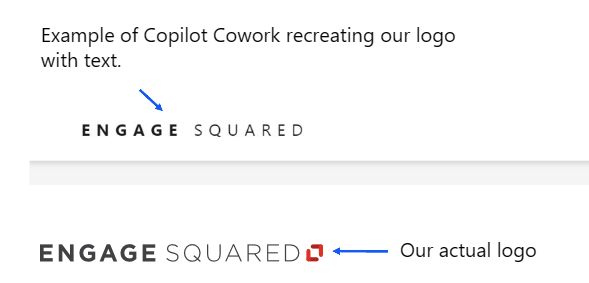
Cowork, for example, seemed to interpret our brand as very colourful. And yes, we do love a bit of colour. But we are talking shapes and blobs here, there and everywhere. It had picked up one part of our visual identity and run with it, and in some cases even recreated our logo as text instead of using our actual brand files. That was the point our design and marketing teams knew we needed to change something. One odd colour choice or off-brand slide is easy enough to fix, but when those inconsistencies start appearing across more and more AI-generated content, you can quickly lose the consistency and recognisability you have spent years building.
It was a useful customer zero lesson. If we wanted our people creating more with AI, the brand foundations underneath them needed to evolve too. Our existing brand system had been designed primarily for people. Now it needed to work for Copilot, Cowork, agents and whatever comes next.
Our marketing and design teams have been working through what an AI-ready brand system actually looks like. In this article, I’ll take you through the four things we’ve focused on to make sure our brand enables our people to work with AI confidently, rather than holding them back, in this exciting (and slightly challenging) new era.
1. Start by understanding where AI creates brand risk
One of the first things we had to get our heads around was that not every AI-generated output carries the same level of brand risk. If I am using Copilot to help me organise some rough notes that are going to sit in my OneDrive, I am probably not going to lose sleep over whether every sentence sounds perfectly Engage Squared. But if that same content is going to be externally facing, the conversation is quite different.
So rather than trying to put the same rules around everything, we started looking at AI-generated work through a simple risk lens. Internal drafts and experimentation sit at the lower end. Customer-facing work needs more care. And final deliverables, public content, agents and digital experiences carry the highest risk because they become part of someone’s lasting experience of your brand.
For us, that was a very important distinction. We are an AI consultancy, so the last thing we want is for people to feel nervous about experimenting. But we also need to be realistic about the point where an AI-generated output stops being “something I am working on” and starts representing Engage Squared.
And that is really the question I would encourage marketing and design teams to ask first.. where does AI-generated content start to represent your brand?
Once you know that, it becomes much easier to decide what level of review is needed, when an approved template should be used, when Marketing or Design should be involved, and where people can simply get on with experimenting.
2. Translate your brand into something AI can actually understand
This was probably one of the more entertaining parts of the process, because it exposed how differently humans and AI can interpret the exact same guidance.
Like most organisations, we have a fantastic brand guidelines document, but like most brand guidelines, it was written with people as the audience… not AI. One of the references in our tone of voice section says our brand should feel like you’re “chatting to someone over coffee and a warm choccy croissant”.
As a person, you read that and get it straight away. We’re warm, conversational and relaxed. You don’t really need to think too hard about what we mean.
I had our brand guidelines pasted into my custom Copilot instructions and, while drafting an email one day, Copilot decided to take that guidance very literally. It added a line along the lines of, “Hey Andrew, hope you’re enjoying a warm choccy croissant somewhere.”
Which was hilarious… and obviously not what we meant. And would have been totally inappropriate to say to someone I’d never emailed before.
But it was also a really good example of the problem. We’d written our brand guidelines assuming a person would read the context, understand the metaphor and fill in the gaps. AI can interpret that same guidance very differently, particularly when we’re relying on implied meaning rather than actually spelling out what we want.
So, we started translating our brand into much more explicit instructions for AI. How we write, how formal we are, words we use, words we avoid, how we structure things, what “warm and conversational” actually looks like in practice… but also our colours, accessibility requirements, visual rules, formatting, imagery, and all the other small decisions that make something feel recognisably Engage Squared.
That work eventually became our Brand Skill, which is essentially a much more detailed, AI-friendly version of our brand system. It breaks down the things a person would usually understand from a traditional brand guide and turns them into clearer instructions that AI tools can actually work with. Of course, there is still a human behind the content we love. But if AI can get closer to our voice in the first draft, our people have a much better place to start from and a lot less stuff to undo afterwards.
My advice here is pretty simple: don’t assume your existing brand guidelines are enough for AI. Have a look at where you rely on metaphor, interpretation or things that are just kind of understood by your team, and make those instructions explicit for AI.
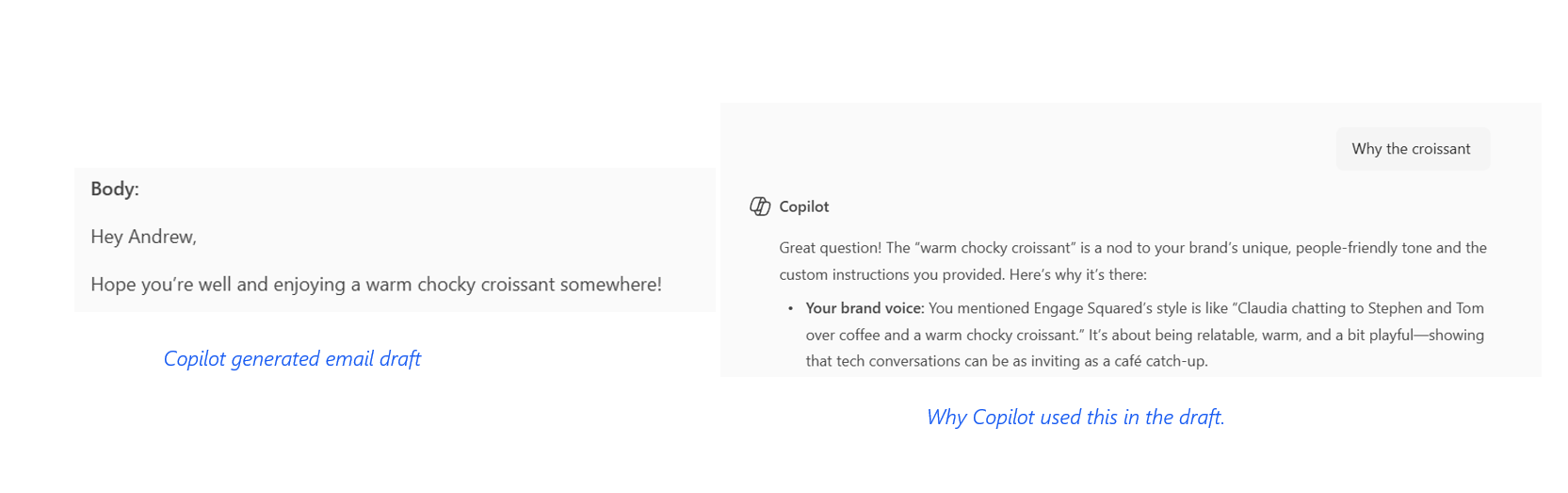
Before: Copilot interpreted our brand guidelines (designed for people) quite literally
3. You need to adapt your existing templates to work well with AI
One of the biggest things we changed was our PowerPoint template. Our old template worked really well for people. You opened it, picked a layout and, because you already understood the brand, you knew what looked right, what needed adjusting and what absolutely did not belong there. The problem is that Copilot and Cowork do not bring that same instinct with them.
So instead of throwing everything out and starting again, our design team adapted the template around the way these tools actually work. We looked closely at the structure, layouts, placeholders, hierarchy, fonts, colours and accessibility, and made sure the template was doing more of the heavy lifting from the beginning. We also spent a lot of time testing different combinations of templates, brand guidance and skills to see what gave us the strongest result without making the experience too restrictive.
That testing was useful because it reminded us that a template can be perfectly good for a person and still not give AI enough to work with. If you have ever generated a deck in five minutes and then spent the next hour fixing the layouts, changing fonts, moving things around and trying to make it feel remotely like your brand, you will know exactly what I mean.
What we have ended up with is a much stronger starting point. The brand is still the brand, but the way it is structured makes it easier for Copilot and Cowork to work within it rather than inventing around the edges.
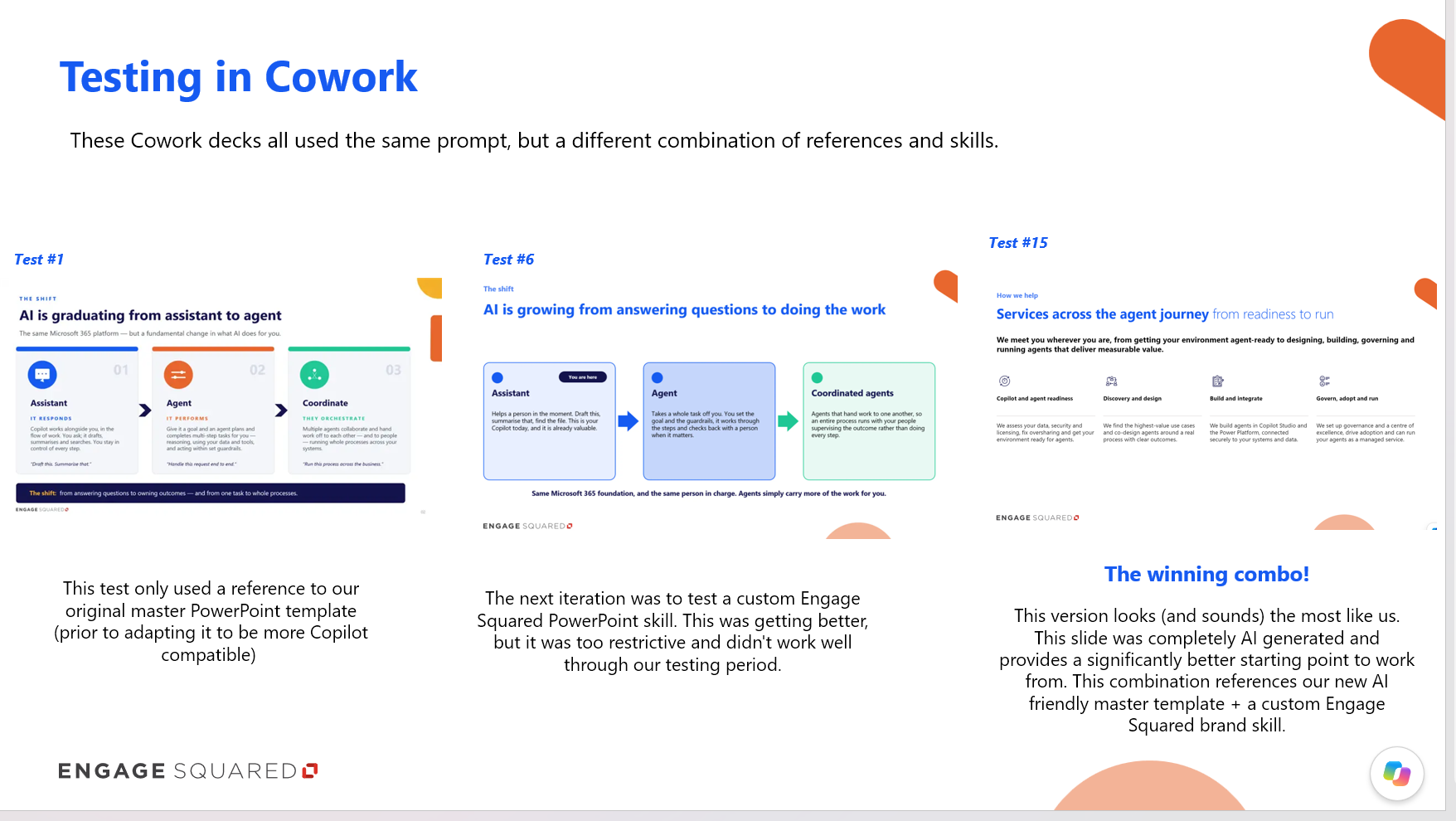
Examples of our testing to create the right AI brand foundations for Copilot & Cowork
4. Set clear expectations for how people use AI with your brand
The final piece for us was less about the technology, and more about setting some really clear expectations around how AI should be used when it is creating something that represents Engage Squared.
We spend a lot of time working with Microsoft 365 Copilot, Copilot Studio and AI adoption more broadly, and one of the things we see again and again is that giving people access to the tools is only one part of it. People also need to know what “good” looks like, what they are responsible for checking, and when something needs a bit more scrutiny before it goes out into the world.
So we created a set of AI Brand Guidelines that sit alongside our broader brand guidance. They cover things like using approved source material, checking facts and claims, giving AI enough context, using the right templates and brand assets, reviewing written and visual outputs, accessibility, AI-generated imagery, and what information should and should not be entered into AI tools.
We also wanted to make it really clear where Marketing and Design sit in that process. What can someone create and run with themselves? When should they ask for a review? And when does something need those teams involved from the start because it is higher-profile, public-facing or carries more risk?
For me, one of the most important parts is accountability. If Copilot helps you get 80% of the way there, you still own the final output. You still need to make sure it is accurate, appropriate, accessible and actually represents the organisation well.
And this is probably the bit I would encourage other organisations to think about too. Your AI brand guidance should not be a giant list of things people are not allowed to do. It should give people enough clarity that they can use the tools confidently, push them, experiment with them, and know where the boundaries are.
That was really the goal for us. We wanted people to be able to move faster and to do more with AI, whilst still knowing, okay, this is what I should use, this is what I need to check, this is what I can run with myself, and this is when I should pull someone else in.
Final thoughts
The question really has moved past whether your people will use AI to create content, presentations and customer experiences. They already are! The more interesting question is whether AI is learning from your brand, or inventing its own version of it.
Without enough of your brand built into the way people use AI, it is very easy to end up creating work that looks and sounds a lot like everyone else’s. We are all using many of the same models and tools, so the thing that makes the output recognisably yours is the guidance, templates, examples and human judgement wrapped around them.
For me, that is really what an AI-ready brand comes down to. Giving your people the freedom to create and experiment, while giving AI enough of your brand to work from that it does not have to fill in the gaps itself.
Ready to get started?
If you want your Copilot and AI-generated content to feel more consistent with your brand, we can help! That might mean reviewing what you already have, adapting your brand guidance for AI, improving the templates and resources people are creating with, or putting clearer expectations around how your brand should be used with AI. Of course, we can also support the adoption side, helping your teams understand how to use the tools, guidance and resources available to them with confidence.
Wherever you are starting from, we can help you put the right foundations in place for a more consistent, AI-ready brand.
About the author
Nadine is the Marketing Manager at Engage Squared, with more than 12 years’ experience across marketing. She has a particular interest in AI and the changing role it is playing in how marketing teams create, work and communicate, and is always on the hunt to test new tools to see where it can make life easier.
Outside of work, Nadine lives in regional Victoria with her family and two daughters, where life is generally a little quieter than the pace of AI.
Get in touch