
App & Cloud Modernisation of MSBase Foundation’s Global Neuroimmunological Disease Registry on Microsoft Azure
The MSBase Foundation is an independent not-for-profit organisation that owns and operates the MSBase Registry – a unique international collaborative registry designed for clinicians working in the field of multiple sclerosis (MS) and other neuroimmunological diseases (NIDs), to collect, track, share and evaluate patient outcomes data.
Client
MSBase Foundation
Service
App & Cloud Modernisation of MSBase
Industry
Healthcare, Medical Research, and not-for-profit
Website
https://www.msbase.org
Context
More than 2.9 million people worldwide face the complex, lifelong journey of Multiple Sclerosis (MS) which is also the leading cause of neurological disability in young adults, between 150,000 and 200,000 people worldwide are affected by the rare, but serious NMOSD (Neuromyelitis Optica Spectrum disorder) and 150–200 per one million live with Myasthenia Gravis (MG). Supporting clinical research for these neuroimmunological diseases requires a system that is scalable, accessible, and agile.
Since 2004, the MSBase Foundation (MSBase) has partnered with clinicians in 45 countries to build one of the world’s largest real-world registries composing of 122,000+ patient records from over 200 clinics. This collaboration turns real-world experiences of people living with MS, NMO, MG, and other neuroimmunological diseases (NIDS) into insights that drive better care and faster research breakthroughs.
To scale this impact, MSBase needed a modern, cloud-based platform that would give clinicians secure access from anywhere, keep every site on the same version, and make onboarding new clinics quick and simple.
Engage Squared partnered with MSBase to deliver iMed Web; a secure, cloud-native, multi-region, multi-tenant registry built on Microsoft Azure. This case study covers Phase 1, the first chapter in a multi-phase modernisation program and the foundation of a strong, ongoing partnership.
Challenge
MSBase’s registry has supported real-world research for years, and their legacy system had served them well. But it wasn’t built for the scale or cloud-first future they were heading towards.
The desktop model relied on local installs for each clinic, with manual updates that left sites running different versions. It worked, but it was time-consuming to maintain and came with high operational overhead. As MSBase looked to the future, they set their sights on faster clinic onboarding, consistent version control, secure access from anywhere, and lower running costs.
The next step was clear: move to the cloud. This would be the first milestone in a longer digital transformation journey, one designed to support MSBase’s growth and their global research mission for years to come.
Our approach
Phase one focused on building the technical foundation for growth while keeping research uninterrupted.
We started with discovery workshops alongside the MSBase product team, mapping workflows, reviewing existing systems, and identifying long-term goals. These conversations shaped a cloud modernisation strategy built on achievable milestones, ensuring that MSBase were able to leverage their existing investments, and realise incremental business value through-out the delivery of their digital transformation journey.
Moving onto project delivery, we worked in a typical Agile manner, following the Scrum framework with a cross functional team that were appropriately skilled for the task at hand. It was vital to build a team that could work collaboratively and transparently with MSBase due to the vast amount of ‘unknowns’ that needed to be faced into, as we worked through various upgrade paths. This allowed the team to be truly agile and to adapt approach as necessary to keep on top of timeline & budget constraints.
Milestone 1: Lifting the platform
Our first milestone in this journey focused on rebuilding the foundation. We refactored key parts of the codebase for better maintainability and rebuilt the front end using the latest version of Angular, whilst upgrading the existing legacy .NET Framework backend codebase to a modern .NET 8 solution suitable for running in the cloud. The result was a secure, cloud-native web application, now known as iMed Web, hosted in Microsoft Azure.
Crucially, we ensured full functional parity with the legacy system. Clinics could continue their work with no disruption, but now with improved stability, access and performance. By removing the need for local SQL installs and manual software provisioning, this set the foundation for easier and faster rollouts.
Milestone 2: Multi-tenancy enablement
With the platform uplifted, we turned our attention to scale. We introduced multi-tenancy, allowing MSBase to provision new clinics in minutes instead of months. Each tenancy has it’s own isolated database, unique URL, and user access, all without deploying new infrastructure.
To make this happen, we built a self-serve multi-tenant admin panel, integrated Entra ID for secure authentication with MFA, and implemented automated deployments using Azure DevOps. This dramatically reduced support overhead, removed version fragmentation, and gave the MSBase team much better visibility over releases.
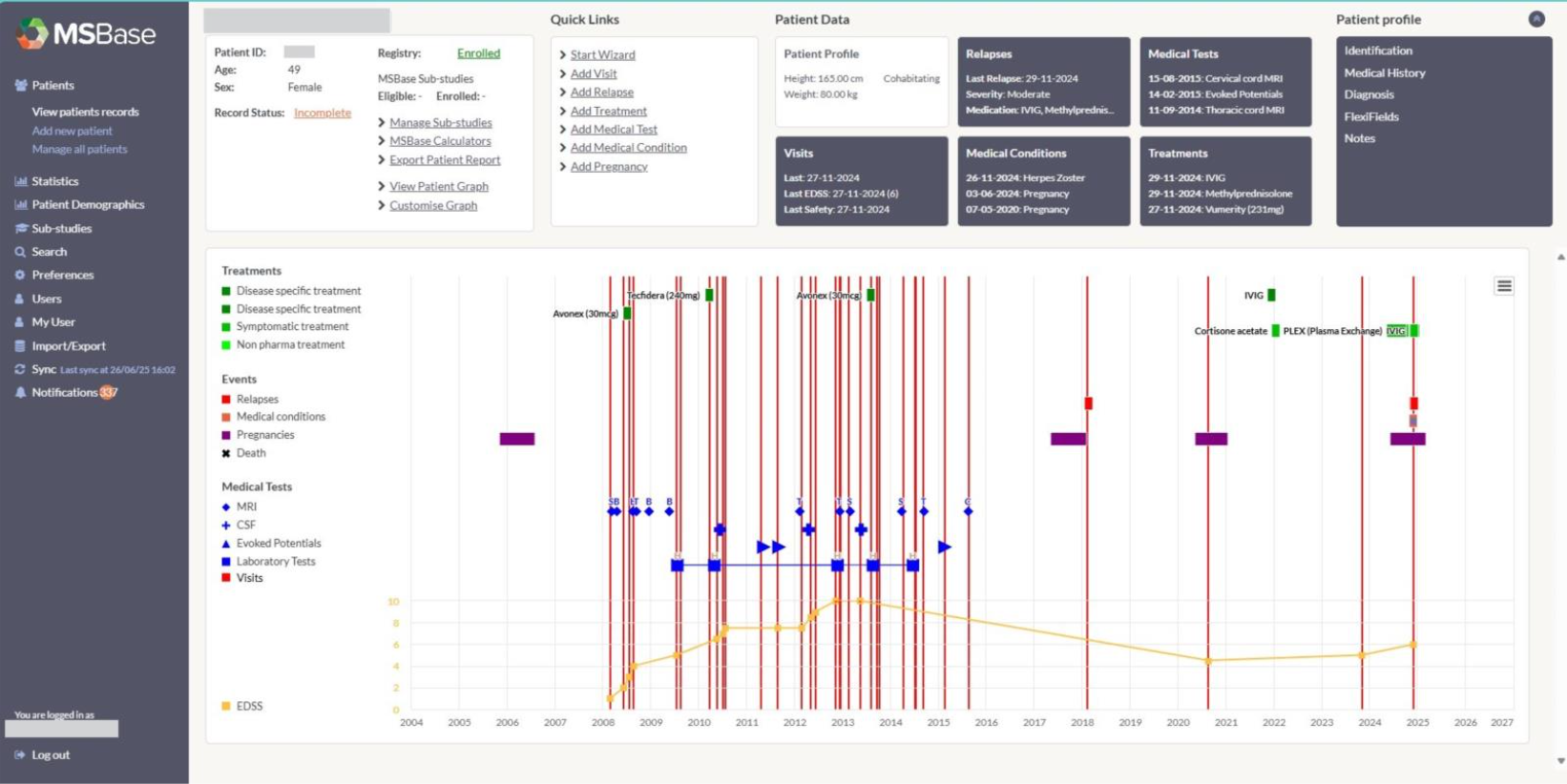
Screenshot of the MSBase Registry
Supporting a vital chapter in women’s health research
Once the technical foundation was in place, we worked with MSBase’s product team to refactor their Pregnancy Module, a critical tool for tracking maternal and infant health in both MS and MG. The updated module now supports richer data capture, including 18 months of postnatal outcomes. This is paving the way for deeper insights into treatment safety, pregnancy progression, and early childhood development.
The significance of this work becomes clear when you look at what MSBase has already achieved. Through their dedicated pregnancy, neonatal outcomes, and women’s health registry, which now spans more than 18,000 pregnancies across 36 countries, MSBase is addressing some of the most important knowledge gaps in MS care.
Research from MSBase data has helped reveal that pregnancy may act as a disease modifier in MS, with the potential to temporarily slow disease progression. They are also tracking the safety of disease-modifying therapies (DMTs) during conception, pregnancy, and breastfeeding, and building one of the most robust datasets of its kind to support evidence-based decisions for women with MS.
Our role was to strengthen the tools that make this kind of research possible. With the refactored module now in place, MSBase is equipped to continue capturing high-quality data and advancing research that is reshaping how clinicians understand and support women’s health in the context of MS and MG.
Results
The work completed in phase one is already making a meaningful difference. Clinics are able to be onboarded faster, researchers have secure access from anywhere, and the MSBase team has better tools to support their global network.
With a more stable and scalable platform in place, MSBase is set up to grow, bringing more voices into the registry and accelerating the research that helps improve lives.
With over 60–80 additional clinics expected to join by the end of 2026, and a global footprint spanning five regions, MSBase are already seeing great results:
- As it stands, 60 clinics live are now using the platform (as of Jan 2026) across Australia, Europe, and MENA.
- A further 80-100 clinics are targeted for rollout throughout 2026, with the aim of scaling to 200+ globally by 2027.
- Clinic “technical” onboarding time in some cases, cut in half from a week or more, to less than a day.
- Global version control ensures consistent research participation across all clinics.
- Secure remote access empowers clinicians to contribute data from anywhere.
- Reduced support burden has freed up time and resources for research.

Before and after
What’s next
With iMed Web in place, MSBase can grow and adapt faster than ever.
The next milestone is launching the an Alzheimer’s and Dementia Registry, the first to use MSBase’s new common data model with 20 research centres already committed for early 2026. In Q1 2026, the plan is to commence the next program of works for all existing disease areas, including MS, NMO, and MG, will migrate to this unified architecture, retiring the last legacy code and creating a fully repeatable, scalable platform for multi-disease research.
MSBase’s mission is to provide the tools, governance, and support needed for global collaboration, turning real-world data into insights that improve lives. We’re so proud to be part of their journey and excited for what’s ahead.